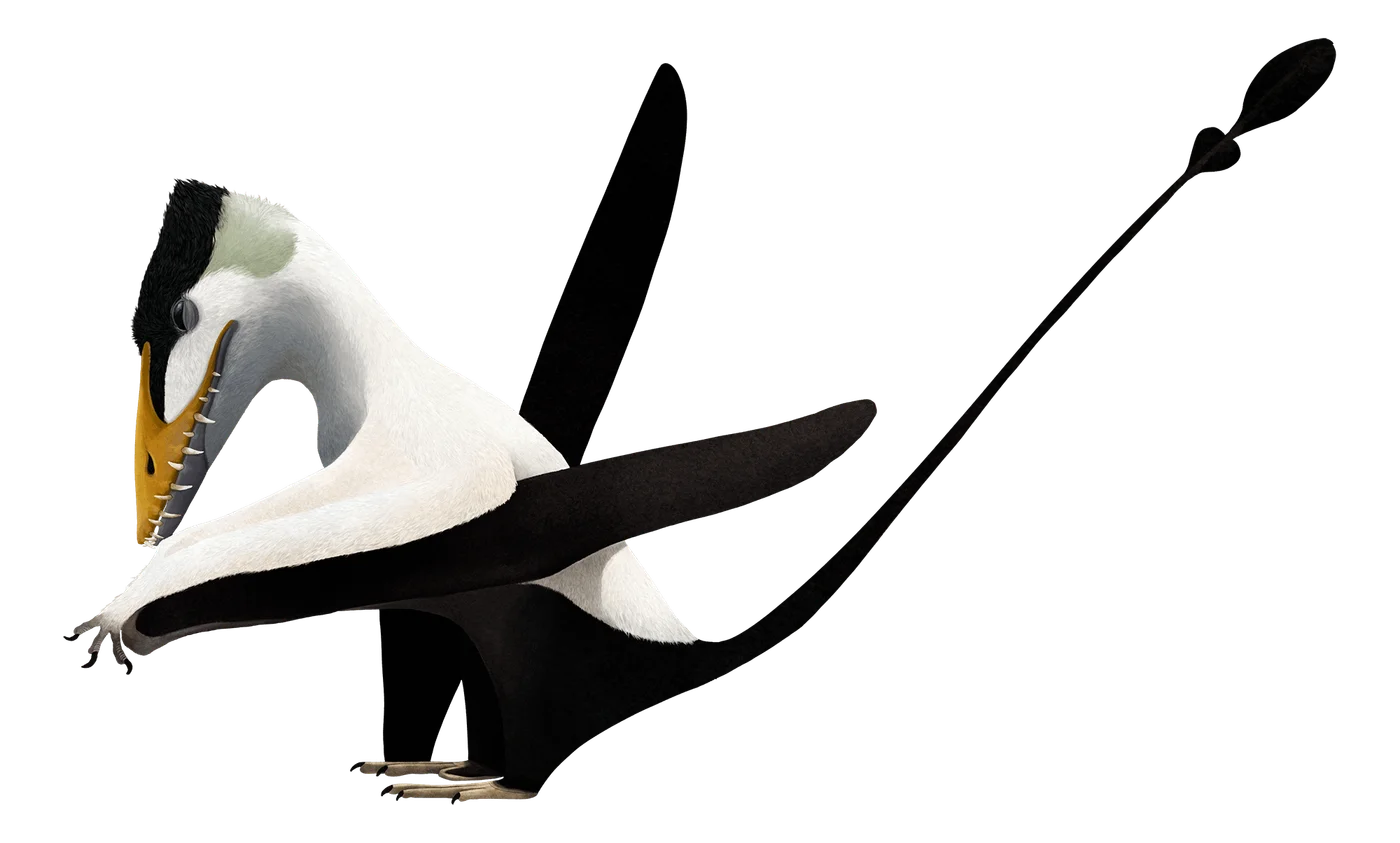
Rhamphinion
Art: Julio Lacerda
All illustrations are copyright their respective artists. Use of any image requires a paid licence — contact us for licensing enquiries.
Rhamphinion
/ram-FIN-ee-on/Rhamphinion is one of the earliest pterosaurs known from North America.
Pterosaur data
Mesozoic era · 252–66 Ma
Wingspan

About this pterosaur
Paleontologist Kevin Padian named and illustrated a new species of pterosaur, Rhamphinion jenkinsi, in 1984 based on portions of a skull found in the Lower Jurassic Kayenta Formation in Arizona. The genus name means “beak nape” and the species name honors paleontologist Farish Jenkins, who found the specimens.
The skull is known from four fragments, one from the occipital region, one from the left cheek, one from the jaws, and another unidentifiable bone fragment. The bones from the cheek region show the lower borders of the large antorbital fenestra and orbit. The portion from the jaws has two teeth. They are recurved cones with longitudinal grooves.
Padian didn’t assign Rhamphinion to any pterosaur family, but considered it to be some kind of early long-tailed pterosaur. A 2017 phylogenetic analysis performed by Wu, Shou, and Andres found Rhamphinion to be a dimophodotid. The skull fragments come from an animal similar in size to Dimorphodon. If Rhamphinion is indeed a dimorphodontid, its wingspan would probably be similar to Dimorphodon, roughly 1.5 m (5 feet).
At the time Rhamphinion lived, roughly 190 million years ago, this part of Arizona was a semi-arid plain crossed by rivers running to the west and the southwest. It probably fed on small terrestrial vertebrates and invertebrates like its cousin Dimorphodon.
Across the network
Credits